How Much Does It Cost to Study Abroad?
A Guide for Pakistani Students Considering Canada
One of the most common questions students ask when considering studying abroad is simple:
“How much will it cost?”
Before deciding on a country or university, most students want a full budget breakdown. The total cost of studying abroad generally includes four major components:
Tuition fees
Living expenses
Health insurance
Travel costs
While costs vary widely depending on the country and university, Canada offers an interesting range—from relatively affordable universities to globally ranked institutions with higher tuition. Understanding these differences can help students choose an option that fits both their academic goals and their financial plans.
Tuition Fees in Canada: A Wide Range of Options
One of Canada’s advantages is that tuition fees vary significantly depending on the university and province. This means students can often find a good university within their budget.
For example:
Lower tuition universities
Universities such as Thompson Rivers University in British Columbia often have international tuition in the range of about $20,000–$25,000 per year depending on the program. Another reputable, the University of New Brunswick and the University of Manitoba, has tuition rates around $25,000 to $28,000 even for engineering programs.
Mid-range universities
Institutions like the University of AlbertaandTrent University typically fall into a middle range compared to Canadian universities.
Higher tuition universities
Top research universities such as University of Waterloo or University of Toronto can reach upward to $75,000+ per year, especially in programs such as engineering or computer science.
Across Canada overall, average international undergraduate tuition varies by province. For example:
Ontario: about $49,800 per year
British Columbia: about $39,800
Alberta: about $34,900
Manitoba: about $21,400
New Brunswick: about $19,300
This variation means that choosing the right province can significantly reduce the cost of studying abroad.
Living Costs in Canadian Cities
Living costs in Canada depend heavily on the city where a student studies. Larger cities tend to be more expensive, especially for accommodation.
Here is a rough comparison of average monthly costs for students:
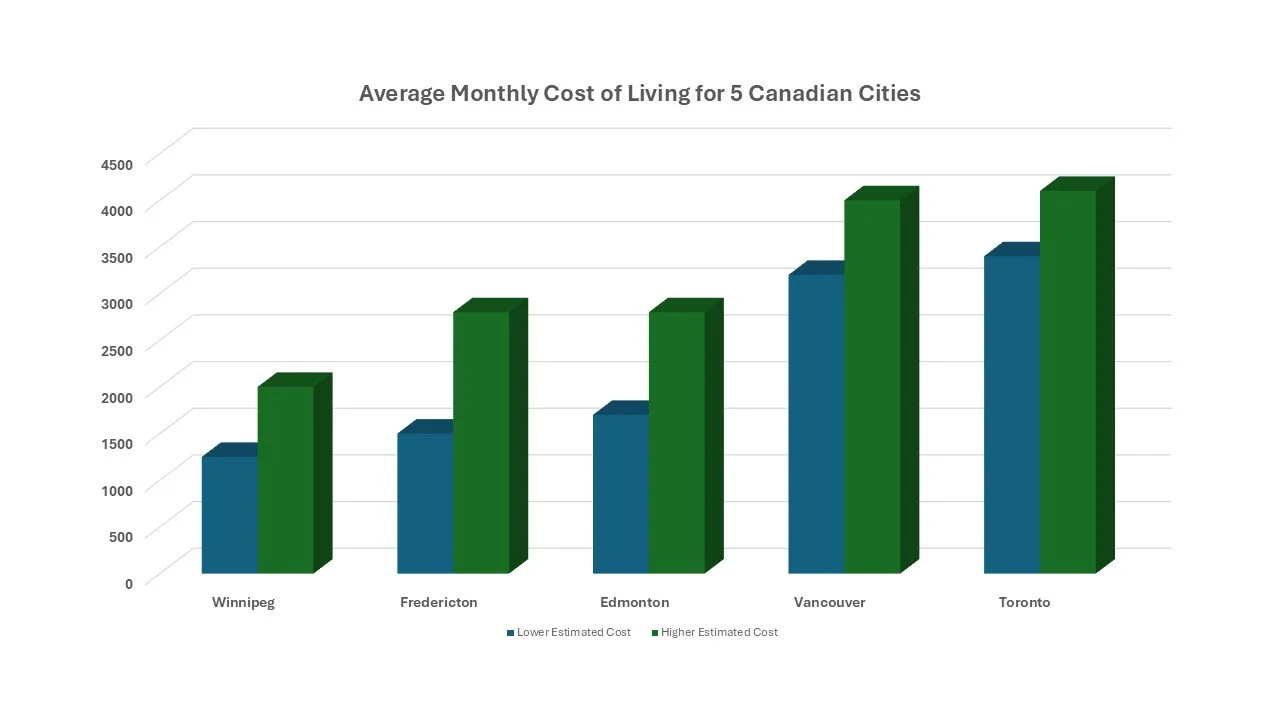
Cost of Living Comparison for 5 Major Canadian Cities
Toronto and Vancouver consistently rank among the most expensive Canadian cities for housing and daily expenses.
Smaller cities like Fredericton, Winnipeg, or Kamloops tend to be more affordable, which is one reason many students choose universities located outside Canada’s largest metropolitan areas.
Typical Student Budget in Canada
A realistic annual budget for international students in Canada might look like this:
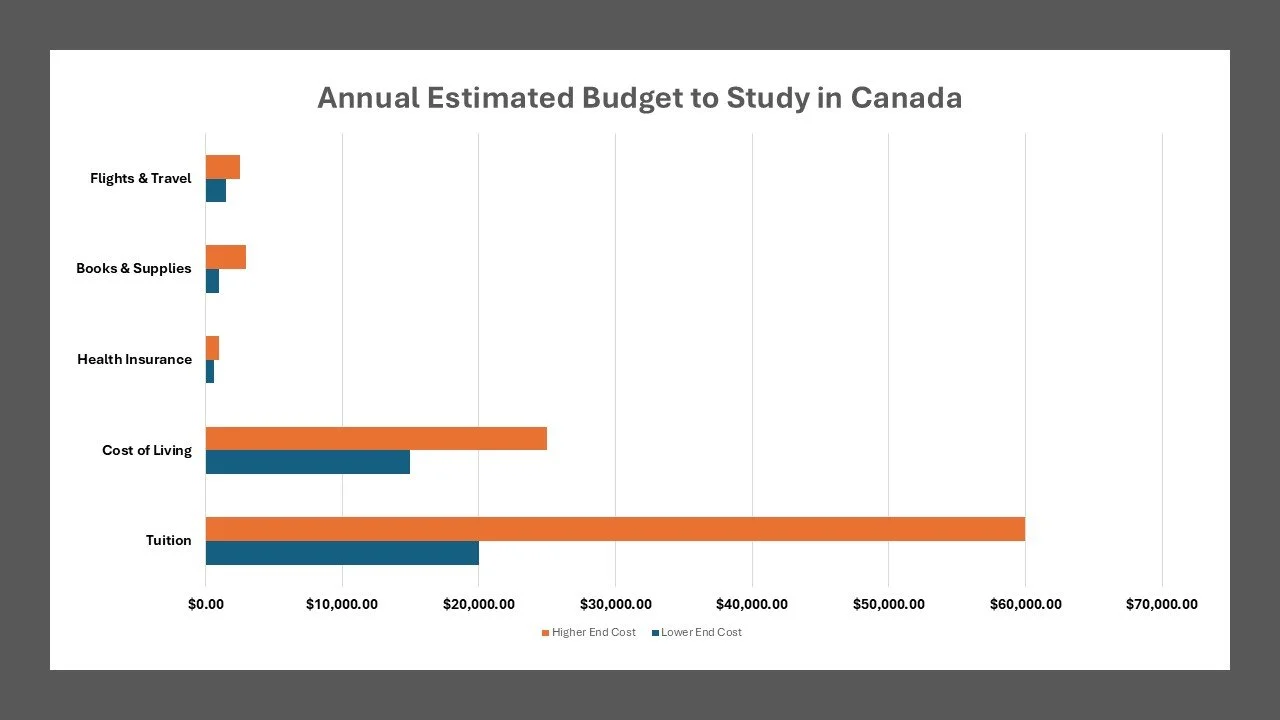
Main Expenses an International Student Can Expect to Spend Annually
Health insurance is mandatory for international students in most provinces and typically costs $600–$1,000 per year depending on the plan and province. International students studying in Alberta do not need to pay into the Alberta Health Care Insurance Plan (AHCIP). This gives a considerable savings to students.
Overall, many students budget $40,000–$80,000 per year depending on their university and lifestyle.
How Canada Compares with Other Popular Study Destinations
Students often compare Canada with other English-speaking destinations such as the United States, United Kingdom, Australia, and New Zealand.
Here is a simplified comparison:
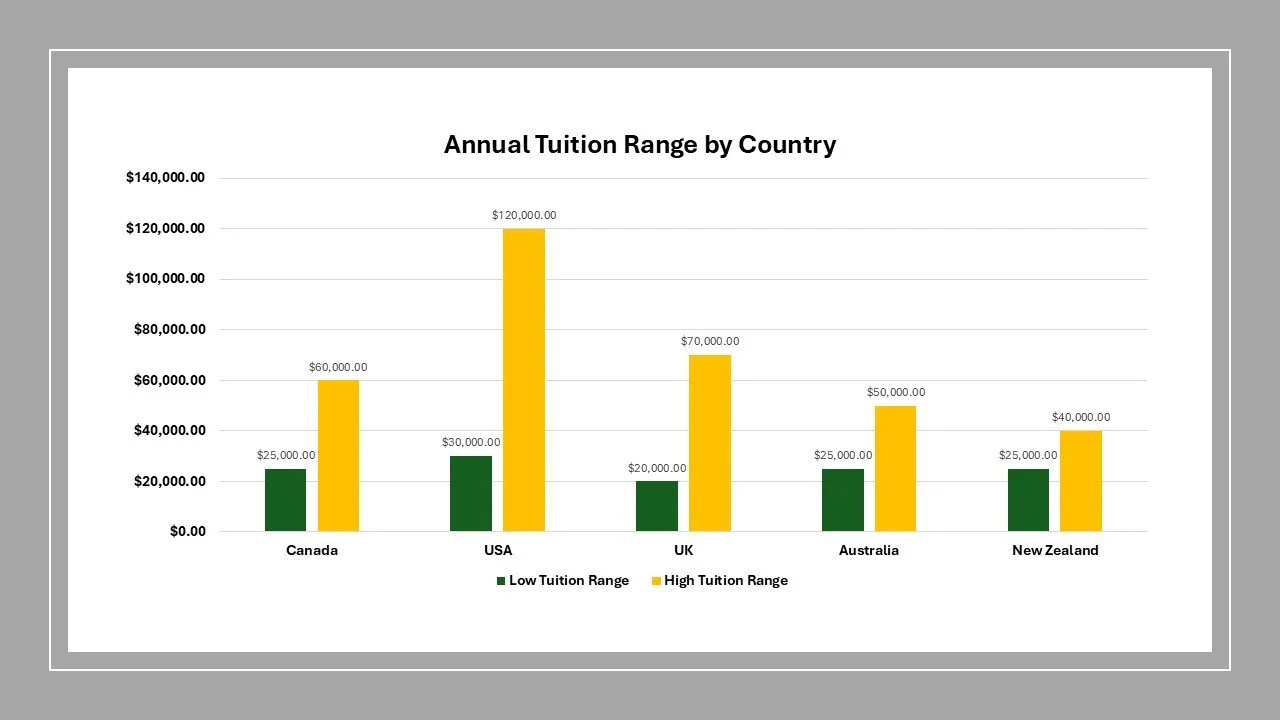
Comparison between Canada and other popular English Speaking Study Abroad Destination
Canada is often considered a good balance between quality and affordability, especially when compared with the United States.
In addition, Canada offers advantages such as:
Post-graduation work opportunities
Immigration pathways for graduates
High quality public universities
A safe and multicultural environment
Choosing the Right Option for Your Budget
The key takeaway is that studying abroad is not one fixed price.
Your total cost will depend on:
the university you choose
the province or city you study in
your lifestyle and accommodation choices
scholarships or financial support
For example, a student studying at the University of Manitoba in Winnipeg may spend far less overall than a student attending University of Toronto in downtown Toronto, simply because of differences in tuition and living costs.
Need Help Planning Your Study Budget?
Understanding the financial side of studying abroad can be complicated, especially when comparing universities, provinces, and visa requirements.
At Go 2 Canada Education Services, we specialize in helping students understand the true cost of studying in Canada, including:
choosing universities that fit your academic goals and budget
understanding tuition differences across provinces
planning realistic living expenses
identifying scholarship opportunities
Because we focus specifically on Canada, and because we are Canadian citizens who have lived and worked extensively in Canada, we are familiar with the financial landscape of Canadian universities and can help students and families make informed decisions.
If you are considering studying in Canada and want a realistic budget plan, feel free to contact Go 2 Canada Education Services for personalized guidance.
Frequently Asked Questions
What is the average cost of studying in Canada?
The average cost of studying in Canada is around $55,000 CAD. Costs could range from $40,000 to $80,000 CAD.
Which university has the cheapest tuition?
Some of the cheapest universities to study at in Canada are Thompson Rivers University, the University of New Brunswick and the University of Manitoba. Tuition at these universities is around $20,000 to $24,000 CAD depending on the program.
What is the cost of living in Canada?
The average cost of living in Canada is around $22,000 CAD. The Canadian government has set an amount of $22,895 (for 2026). Cost of living varies from city to city and province to province.
What is the cheapest city?
One of the cheapest cities in Canada is Winnipeg, home of the University of Manitoba, an elite member of the U15 research intensive group of universities.
Is Canada expensive compared to the UK, USA, Australia $ New Zealand?
The USA is the most expensive country based on tuition, cost of living and the value of the US dollar. The UK is the next most expensive and Canada is comparable to Australia and New Zealand.
Where is the best place to study?
The best place to study depends on your desired program, your budget, your desired learning environment and employment opportunities during and after studies.