What is Financial Aid? Understanding Financial Aid for International Students in Canada
Studying in Canada is a dream for many, but for international students, the price tag can be daunting. While Canadian institutions offer various forms of support, there is often a significant disconnect between how these universities define "financial aid" and how prospective students—particularly those from Pakistan—perceive it.
This article explores the mechanics of financial aid in the Canadian system and highlights the crucial cultural and structural differences in understanding between Canadian universities and Pakistani applicants.
Part 1: What is Financial Aid in Canadian Universities and How Do You Apply?
In the context of Canadian higher education, "financial aid" is an umbrella term that encompasses specific types of funding. Unlike domestic students, who have access to government loans, international students rely on a different mix of resources.
The Components of Financial Aid
For an international student, financial aid in Canada generally consists of three pillars:
Scholarships and Awards: These are merit-based. They are awarded based on academic excellence, athletic achievement, or community leadership. They do not need to be repaid.
Entrance Scholarships: Automatically awarded upon admission based on high school grades (often requiring an 80% or 85%+ average).
Major Entrance Awards: Significant amounts (sometimes covering full tuition) that require a separate application and usually demonstrate exceptional leadership or extracurricular involvement.
Bursaries: These are need-based. They are designed for students who demonstrate financial need. Unlike loans, bursaries are non-repayable grants. However, they are often smaller than scholarships and are usually available to upper-year students rather than freshmen.
On-Campus Employment: While not a "grant," Canadian immigration rules allow international students to work up to 24 (as of 2026) hours per week off-campus or unlimited hours on-campus during breaks. Many universities like the University of Alberta and Western University include work-study programs as part of their financial aid package, guaranteeing a job on campus to help cover costs.
The Application Process
The application process is decentralized, meaning every university has its own system. However, the general steps are:
Apply for Admission: In Canada, you must have applied for admission and in some cases even been accepted before being able to apply for major scholarships. Admission is a precondition of scholarship offers. Many merit-based entrance scholarships are automatic; your admission application serves as your scholarship application.
Research Specific Portals: For major awards, universities require a separate application via their student portal (e.g., "MyTrent" or the university’s specific scholarship center).
Submit Documentation: For need-based bursaries, students often must submit a "Student Financial Profile" or bank statements proving their financial constraints.
External Sources: Students must also look outside the university. The Canadian government offers the Vanier Canada Graduate Scholarships for doctoral students, and organizations like the Aga Khan Foundation offer specific aid for students from developing nations.
Part 2: What is Financial Aid to a Canadian and a Pakistani Student?
The term "financial aid" carries different connotations in Pakistan versus Canada. This divergence in understanding often leads to frustration, unmet expectations, and financial stress for Pakistani students.
The "Full Ride" Expectation vs. Partial Support
In Pakistan, the concept of financial aid is heavily influenced by programs like the USA’s Fulbright Scholarship or specific corporate sponsorships which historically offered "full rides"—covering tuition, airfare, and living stipends.
Pakistani Perspective: Students often approach Canadian universities expecting a comprehensive package that covers all expenses. They apply hoping that "financial need" will translate into a full fee waiver.
Canadian Reality: Canadian universities rarely offer 100% funding to international undergraduates. An "entrance scholarship" might be merit-based, $5,000 or $10,000 CAD—a significant sum, but often only a fraction of the $40,000+ annual tuition. Canadian institutions view financial aid as a "discount" or a contribution, not a full sponsorship. Some universities like Trent University, the University of Alberta and Western University offer scholarships in excess of $100,000 which can cover 50% to 100% of tuition but not cost of living.
Loans vs. Grants
Pakistani Perspective: In Pakistan, the term "aid" is often synonymous with grants or charitable support (Khairat). The concept of a student loan is viewed skeptically due to high interest rates or religious restrictions on interest (Riba). Consequently, Pakistani students often ignore loan options, focusing solely on grants.
Canadian Reality: For Canadian citizens, "financial aid" is synonymous with government student loans. While international students cannot access these federal loans, Canadian universities structure their aid systems around the expectation that students will use a mix of savings, family support, and part-time work. They do not view their scholarships as sole support mechanisms. Some private lending institutions like MPower Financing will provide loans to international students.
The "Guaranteed" vs. "Competitive" Mindset
Pakistani Perspective: There is a tendency to view financial aid as an entitlement for those with high grades. A student with A1 grades in Matric/Intermediate expects that a university should fund them.
Canadian Reality: Canadian universities operate on a competitive global market. High grades are the baseline, not a guarantee. Admissions officers look for "holistic" profiles—volunteering, leadership, and research potential when it comes to scholarships. A student with perfect grades but no extracurricular activities may be admitted but receive only merit-based financial aid which is smaller in amount. This type of student can be well served at a university like MacEwan University where tuition is affordable and they have the renewable, merit-based Chancellor scholarship. Students with strong extracurricular and leadership profiles are more likely to be awarded a prestigious major scholarship that will cover a significant amount of their tuition. This reality can be confusing to students who have average academic results and a strong extracurricular activity profile. Where marks are king, this student may not qualify for any scholarships. This student is best to consider reputable Canadian universities with affordable tuition, such as the University of Manitoba, UNB or Thompson Rivers University.
Frequently Asked Questions?
Can I get financial aid to study in Canada?
Financial aid, if defined as scholarships and bursaries, the answer is yes, these are available. But if international students are looking for loans, these are extremely rare for international students.
Can I get a full-ride scholarship to study in Canada?
Full scholarships are rare at the undergraduate level but partial partial funding opportunities exist. Some universities like the University of Toronto has a full-ride scholarship but others like the University of Alberta, Western University, Trent University offer scholarships that cover a substantial amount of tuition but not cost of living.
Are scholarships automatic or do I need to apply separately?
There are 2 main kinds of scholarships offered to students in Canada. One is the merit-based scholarship for which students are usually automatically considered for based on their admission average. The second most common scholarship is the application-based one that students need to apply for to be considered for them.
What grades or profile do I need to qualify for a scholarship?
The minimum percentage needed to be considered for a scholarship is 80%. This percentage would give you the minimum amount of scholarship. The higher a student’s admission percentage, the more scholarship money the student might receive. For the larger dollar valued, prestigious scholarships, excellent academics and a strong extracurricular activity and leadership profile is necessary. See this chart from Wilfrid Laurier University as an example of what amount an international student might be eligible for based on his or her grades.
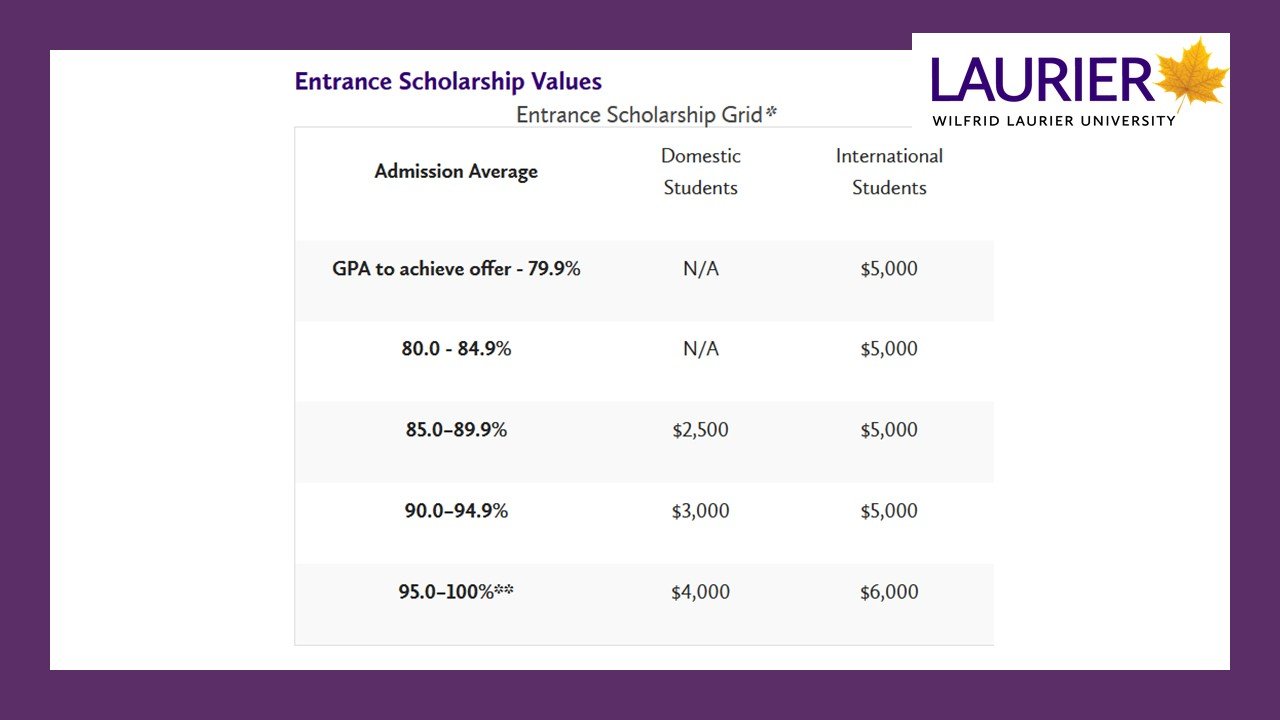
President’s Gold Scholarship at Wilfrid Laurier University
Which Canadian universities offer the best scholarships?
Some of the best scholarships are found at the University of Alberta, Western University, Trent University, UNB, the University of Toronto and McMaster University.
Conclusion
For international students, Canada offers high-quality education and reputable financial support, but it is rarely a "free ride." Understanding the Canadian definition of aid—as a mixture of merit-based discounts and work opportunities—is the first step.
For Pakistani students, the key is to shift expectations away from full sponsorship and toward a "portfolio" approach: combining personal savings, family support, partial scholarships, and part-time work. By bridging the gap between the desire for full support and the reality of partial funding, students can plan their finances realistically and avoid the pitfalls of the aid application process.
For Pakistani students who want help building a scholarship ready profile, consider contacting Go 2 Canada Education Services to help you understand the complexities of the Canadian scholarship application process and to build your profile.
Helen Khan is a Canadian education advisor with over a decade of experience supporting students in Pakistan. A former staff member of the University of Alberta, she provides expert guidance on studying in Canada, including university selection, applications, and scholarships.